

Oct 15, 2025
Beverly Smet | SVP, Global Accounts, Precision AQ
Co-authored by Fonny Schenck (former CEO, Across Health).
In our first blog,1 we confirmed in an evidence-based way that omnichannel is a key driver of CX in biopharma – and that CX, in turn, is a critical component of brand performance. Nevertheless, companies continue to strongly overestimate their CX score versus what customers think (the so-called CX perception gap). In this follow-up we zoom in on the importance of a multimetric mindset – i.e. a balanced set of CX indicators – drawing on data from industries at large and from Precision AQ’s own insights into HCP engagement.
Before we get started, a quick refresher…
As a refresher, these were the key points of our first blog:1
- CX is a business-critical driver: 60% of brand NPS in pharma is driven by CX factors vs 40% by product features.
- Omnichannel has a measurable impact on CX.
- The CX perception gap remains large (50+%), although leading companies are starting to consider/use external/customer perceptions – also in pharma.
“What a business needs most for its decisions – especially its strategic ones – are data about what goes on outside it. Only outside a business are there results, opportunities and threats.” – Peter Drucker
The way forward for business-critical CX management: A balanced set of KPIs tracked over time… and benchmarked externally
In a joint UK study reported this summer in Marketing Week,2 Kantar and Google found that 60% of marketers do not measure whether their work is delivering on business outcomes – and yet 71% agree that senior management pressure to demonstrate effectiveness has gone up in the past three years. In pharma too, balanced CX performance measurement is quite rare. Indeed, most biopharma marketers continue to focus on a few quantitative leading metrics (visits, clickthroughs, etc.), and do not consider qualitative KPIs, lagging measurements, or relative performance vs. their competition. As a result, concerns over proving ROI has been a top-2 bottleneck in pharma ever since the first edition of the Precision AQ Maturometer (in 2008!) through to today.3
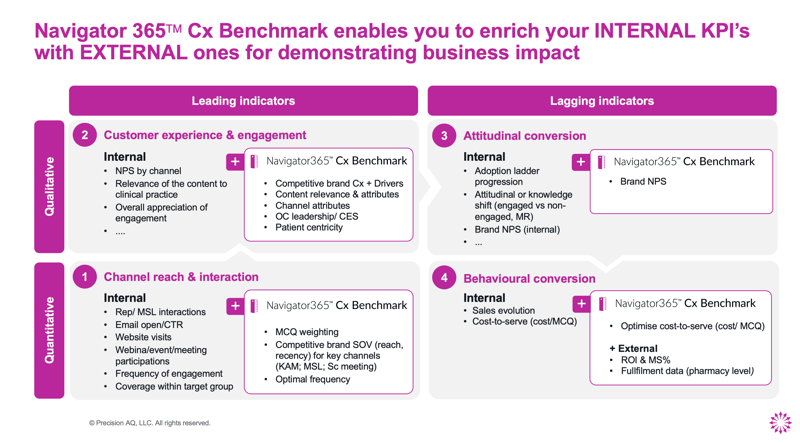
A balanced, lean set of KPIs tracked over time is the way forward for continuously improving business impact through CX. This can be a combination of internal and external KPIs, many of the latter being trackable with the Precision AQ Navigator365™ Benchmark, as the figure below shows. The model also suggests a flow: if leading quantitative indicators (step 1) are followed by a positive experience (step 2), then the two types of lagging indicators (qualitative and quantitative) will follow (steps 3 and 4). By including the external/competitor dimension in the model, you also get a relative view – indeed, even if some of your numbers go up, the leader’s may be going up even more. And by tracking your key metrics over time within the relevant competitor set, you can optimise your go-to-market model in an agile way.
"If you know the enemy and know yourself, you need not fear the results of 100 battles.” – Sun Tzu
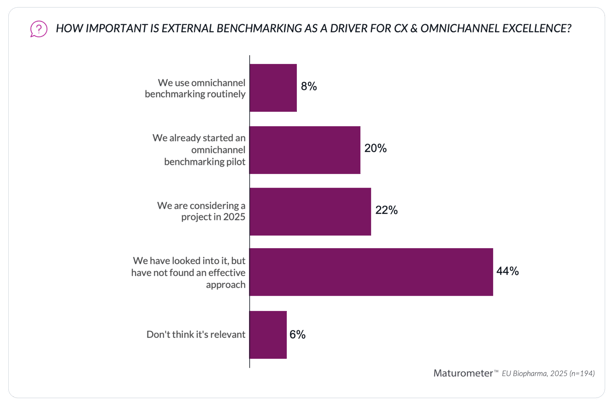
Regarding the important dimension of the competitor perspective as seen through the eyes of the customer, there appears to be a growing awareness among EU biopharma experts. While only 8% claim to have used omnichannel benchmarking routinely in 2025, 20% have started a pilot in this space, and 22% are considering one, while 44% have not yet found a good solution. Only 6% find external benchmarking irrelevant.3
So, what to measure?
According to the 2025 Maturometer,3 the following four measurement concepts are used/considered most often:
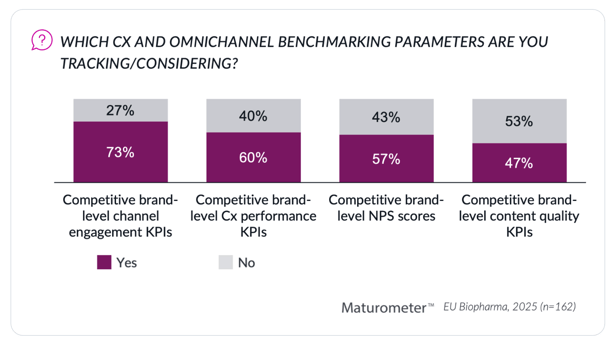
Brand-level measurement: It is key to measure at the brand level, not at the aggregate company level. The latter is not very differentiating, and at the same time, brand-level performance may vary strongly depending on the therapeutic area.4
Channel selection: It’s key to focus on channels ideally offering reach, impact (which we can quantify and compare using MCQ) and frequency at the same time. High-impact channels with low reach and/or frequency will fail to have a rapid and strong impact on the market, for example. In channel prioritisation, a mix of in-person, virtual, and digital self-service options should be offered. This is McKinsey’s “rule of thirds”: at any given stage in the buying journey, or for any customer archetype, one third of customers prefer one of these three channel types.5 And as 42% of B2B customers use more than 11 touchpoints (up from 2016’s five-channel average), integrating these priority channels in a seamless, omnichannel way (while taking real cost-to-serve constraints into account) is a prerequisite for a positive customer experience.
Competitive CX performance is the second-most tracked KPI. A seamless omnichannel performance plays a key role, but there are a few extra CX drivers to be considered, such as knowledgeable staff/trust, ease of engagement, fast response, and respect for customer time to get the full picture.
NPS and related metrics: Almost on par with CX performance, NPS is the third KPI type tracked in CX measurement in pharma. As we saw in our first blog on this topic,1 NPS is influenced by product performance as well, but customer experience has an even stronger impact on the score (60%). Also in the broader B2B world, NPS is the gold standard of customer experience metrics and is used by almost 41% of companies.6 NPS provides a wider view of your customer experience with every aspect of your brand.7 B2B companies sometimes also use metrics like CSAT (Customer Satisfaction) and/or CES (Customer Effort Score), but at a much lower frequency (26% and 11%, respectively). These KPIs only offer insight into a customer’s most recent interaction with your company vs. the broader, more holistic NPS. In pharma too, CSAT and CES are used less frequently—and give a much less clear and actionable outcome.4
Importantly, the simplicity of NPS is attractive, but you need to dig deeper than the simple aggregate number. For instance, it is key to not only survey your best customers, but offer a broader sample. Also, your own company’s NPS score doesn’t exist in a vacuum: bringing your NPS from 20 to 30 might sound impressive, but that growth does not mean much unless it’s outpacing rival brands in the space.8 Another illustration: if you make huge business improvements by moving twos and threes to fours and fives, you do not see any impact on NPS – while the business may in fact have gone up.
“Your score may be going up, but your competitors could be going up higher and faster and you do not know that. And so you are patting yourself on the back, and yet all of a sudden you see customers attriting.” – Maureen Burns, Partner at Bain & Co
Content effectiveness: Content may be king, but it is tracked the least frequently – despite all the noise about hyper-personalised content. More focus on populating prioritised channels with relevant content based on customer journey stage, learning style and competitive positioning will be needed to ensure a superior CX. And less is more here, too: despite ever more content being developed, over 70% goes unused.4
In an ideal world, all four types – channels, content, CX and NPS – are included in a robust external benchmarking programme, resulting in the following predictive model:
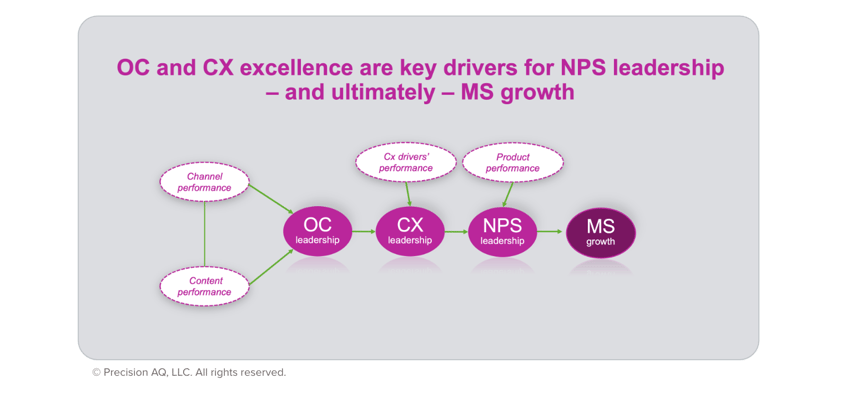 A recent Precision AQ deeper dive into client and Navigator365 Benchmark data (across seven brands and two European markets) illustrates the causal relationships clearly. We look forward to sharing this soon, but in the meantime the key points of this analysis include:
- Omnichannel performance aligns strongly with CX performance (0.84 correlation)
- Omnichannel breadth correlates strongly with NPS and market share leadership
- Intent to Rx more correlates strongly with current prescribers’ NPS score
“Benchmark your performance against your best competitors. Think how you can beat them next time.” – Brian Tracy
Conclusion
In an increasingly customer-led world, identifying a small set of relevant, actionable KPIs to assess and improve your brand’s CX over time has become a key business priority – in biopharma as well as the broader B2B world. A balanced, multi-metric measurement framework needs to be established – and the impact of the prioritised actions needs to be tracked on a regular basis.
Indeed, CX isn’t a checklist you can tick off at board meetings. It’s a commitment to knowing how your customers actually experience your and competitors’ brand-level omnichannel engagement – not just what you think or hope they experience. The companies and brands that will lead are not the ones talking about CX, but the ones working on improving it – across departments, step by step, customer by customer, as another Precision AQ case study nicely illustrates.9
This blog is the second in a short series offering a practical guide to benchmarking customer engagement for focused, measurable improvement. In our next post, we’ll shift from why and what to how: exploring the most effective ways to apply external CX benchmarking. We’ll cover practical questions of frequency and prioritisation, and share a perspective on the limited but evolving role of AI in this space. You can subscribe to this upcoming blog here.
To discover how Navigator365™ Benchmark can help uncover actionable customer insights and drive meaningful improvements in your brand’s customer experience and performance, get in touch!
References
- Smet, B. et al., June 2025: How to bridge the CX perception gap through robust external benchmarking. Available at: https://www.precisionaq.com/en-gb/blog/how-to-bridge-the-cx-perception-gap-through-robust-external-benchmarking
- Rogers, C., June 2025: 60% of marketers don’t measure if work is delivering business outcomes. Available at: https://www.marketingweek.com/marketers-measure-business-outcomes/
- Precision AQ, September 2025: Maturometer 2025 Report (data on file – to be published)
- Sienra, S., May 2023: 3 Questions Biopharma Marketers Need To Ask About Commercial Content Effectiveness. Available at: https://www.veeva.com/blog/3-questions-biopharma-marketers-need-to-ask-about-commercial-content-effectiveness/
- Plotkin, C., et al., September 2024: Five fundamental truths: how B2B winners keep growing. Available at: https://www.mckinsey.com/capabilities/growth-marketing-and-sales/our-insights/five-fundamental-truths-how-b2b-winners-keep-growing
- Luck, I., April 2024: NPS vs CES vs CSAT: Which Customer Experience Metric To Use? Available at: https://customergauge.com/blog/nps-csat-ces
- Smet, B., January 2024: Searching for the “ultimate” KPI for HCP customer experience in biopharma. Available at: https://www.precisionaq.com/en-gb/blog/searching-for-the-ultimate-kpi-for-hcp-customer-experience-in-biopharma
- Wassel, B., August 2025: NPS has its flaws – but when is it the right tool for the job? Available at: https://www.customerexperiencedive.com/news/nps-flaws-right-tool-for-the-job/757700/
- Scholler, P., May 2025: Driving biopharma brand success with benchmarking insights and collaborative action. Available at: https://www.precisionaq.com/blog/driving-biopharma-brand-success-with-benchmarking-insights