

Oct 7, 2026

Authors: Ross Maclean, MD, EVP Partner, HEOR; Melissa Maravic, PhD, MPH, Vice President, Primary Data Collection; Jorge Soler, PhD, MPH, Director, Primary Data Collection
“Patient centricity” is an almost ubiquitous aspiration among biopharma firms’ mission and admirably so. After all, what loftier goal is there for a human than to dedicate his/her professional life to alleviating suffering and improving the health of others? Many elements contribute to a corporation fulfilling a commitment to patient centricity, yet the foundation is anchoring the R&D process in a deep understanding of the patient experience of the disease for which a new treatment is being developed. So how exactly does one “understand the patient experience?”
Collecting primary data from patients is essential to understanding the patient experience, strengthening approaches to shared decision-making, and improving patient outcomes. The default methods for capturing patient experiences are interviews and focus groups. While these methods are familiar and can be effective, their application can often be formulaic, weakening the value of the insights generated.
In this brief article, the authors outline five complementary approaches to capturing the voice of the patient in a real-world setting. The relative strengths and limitations of each approach are described along with the “ideal” use case. This approach offers the biopharma R&D leader a useful guide for engaging their research colleagues to achieve the desired insights. Rich insights from a robust, appropriate research methodology can, in turn, be critical to informing related R&D priorities such as clarifying the unmet medical needs, identifying appropriate clinical trial endpoints, selecting patient-reported outcomes (PRO) instruments for inclusion in clinical trials, and positioning the soon-to-launch product.
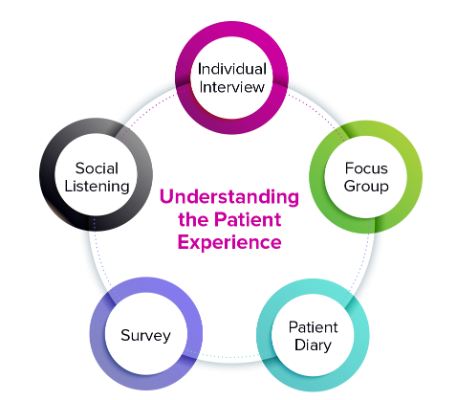
1. Individual Interview
Interviews and focus groups are sometimes used interchangeably, when in fact they have distinct strengths and weaknesses. When seeking to understand a patient’s experience of illness, care, or treatment, an individual interview, also known as an in-depth interview (IDI), is more effective. An interview can provide the space and privacy for a patient to share his/her experiences in detail and for the interviewer to probe more deeply into key moments and delicate, personal topics. Interviews require a skilled interviewer who can quickly build trust to explore these sensitive issues with a patient.
The downside of the IDI approach is that it may require multiple sessions, if feasible, to identify and discuss all topics, making it less ideal for identifying issues that are unknown or unrecognized by the interview subject; it may also have capacity limits due to its labor-intensity. It’s relevant to note that IDI is an optimal way to inform focus group or survey design but can also serve as a follow-up technique to inform interpretation of survey research results.
Within the interview domain is an interesting subtype called the “ethnographic decision tree study.” This unusually titled technique offers predictive insights into the decisions patients will make under certain circumstances, which can be useful for understanding treatment decision-making. Through qualitative interviews, the researcher gathers decisions, reasons, and constraints. These inputs are then diagrammed and tested, offering a visual representation of decision-making processes and considerations.
2. Focus Group
Focus groups harness the power of group think and are best suited to collecting reactions, reflections, and opinions on a product, program, or topic. The strength of focus groups lies in the social interaction between participants, which requires a moderator who can create a balanced environment, effectively set up the topic, and then ideally step back and allow participants to engage with each other, with minimal guidance or probing. Discussion requires skilled moderation to draw out balanced insights from across participants. A focus group supports efficient insight gathering with groups of 4-10 people at a time. Strategic participant recruitment is especially critical here to achieve the needed blend of participant experiences, backgrounds, and characteristics for the group dynamic.
3. Patient Diary
There are other qualitative methods that we can utilize to more fully understand the patient experience. These include diary studies in which participants complete written, audio, photo, or video diaries in response to provided prompts. In the current era of digital media, digital patient diaries present a unique opportunity to creatively engage study participants in data collection. Diary studies center the participant’s perspective and can be useful for understanding time and effort allocation, symptom changes, responses to stress, and medication management. The patient is in control of the data that are captured, giving the researcher a window into what is important to the patient. Often, but not necessarily longitudinal, diary studies are beneficial for capturing change in behavior and effort over time.
4. Survey
Quantitative surveys allow researchers to collect the views from a larger pool of people in a single online exercise and can help identify broader trends and outlier ideas or experiences. They are typically highly publishable, although certain challenges may exist regarding the generalizability of the survey insights, contingent on the survey design, sampling approach, and respondent representativeness. Surveys are constrained by the framing of the questions and related challenges such as recall bias even when “free text” survey responses are offered, and practical limitations around survey length and the attention span of respondents. Surveys can be unsuitable for some populations such as pediatrics, people with cognitive impairment or some mental health conditions, those who are functionally illiterate, or lack access to technology.
5. Social Listening
Social listening involves the collection and analysis of social media posts; it has been used in post-marketing safety surveillance and can be applied to exploring the patient experience on a considerable scale. As more patients share experiences in the digital space, such as on X (Twitter) or video (Instagram & TikTok), there is a wealth of data that can be accessed and analyzed. While social media data may encounter quality challenges, this approach can also surface blind spots in our understanding of the patient experience.
3 Key Takeaways of Collecting the Patient Perspective
There is no need to return to graduate school to pursue a formal education and training in what social science practitioners often refer to as “mixed methods” research. Colleagues within your HEOR function understand the range of available methodologies and their utility, and can guide you to the best possible method for answering the question at hand within the time constraints and resources available.
There are three take-home messages:
- Start Early: Most illnesses are heterogeneous and therefore require an in-depth description of the range of experiences to quantify the unmet medical needs and inform the commercial opportunity and regulatory path.
- Think Broadly: Understanding the patient experience informs the entire biopharma R&D and commercialization program, not just PRO selection for a clinical trial.
- Invest Wisely: Collecting patient insights does not mean “fund a registry,” and all that entails. Modest, focused investment in the types of studies outlined in this article can be undertaken for a fraction of the cost of a clinical trial program and deliver disproportionate impact.
Capturing the patient experience is invaluable to understanding the basis for patients’ unmet medical needs and the R&D program upon which it is anchored. From clinical trial endpoints, including the selection of PROs and performance measures in post-approval, and value-based agreements with payers/HTA to the reason why people seek care in the first place and why patients are willing to adhere to prescribed medicines long term, the knowledge of “what really matters to patients” and thus the value of such studies is self-evident.
Capturing the voice of the patient will almost certainly be one of the wisest R&D investments biotech and pharma companies will make. To find out how Precision AQ's HEOR team can help you understand the patient perspective, contact our team today.