

Aug 5, 2026

Author: Lou DeLoureiro, MBA, VP, Analytics Consulting
Recently, Precision AQ introduced the Predictive Access Engine (PAE): what a benefit or policy is designed to do and what actually happens can be two different things, and the first sign of that disconnect usually shows up in claims, not in policy.
Medicare Part D after the Inflation Reduction Act is a useful test case, though not for quite the same reason. The cap largely did what it was supposed to do: reduce total annual exposure for high-cost patients. But the redesign left a second problem unresolved, not whether the benefit exists, but whether patients understand it and use it when it matters. As a result, CMS launched a payment-smoothing program alongside the cap to address the timing of that cost.
What the IRA Actually Fixed
The IRA introduced Medicare Part D's first annual out-of-pocket (OOP) cap, reducing maximum beneficiary liability to $2,000 in 2025 and $2,100 in 2026, fundamentally changing annual affordability for patients on high-cost therapies.
The first fill has always carried a heavier burden for many high-cost specialty products. The IRA made both the annual cost and the initial fill cost much smaller, but smaller is not the same as small. For some patients, the first transaction can still incur a considerable cost, and unless they understand the next steps, the benefit can initially appear less beneficial than it truly is over the year.
Figure 1 tracks a single, real-world patient: a Medicare beneficiary, near-perfectly adherent on Stelara, across the IRA phase-in.
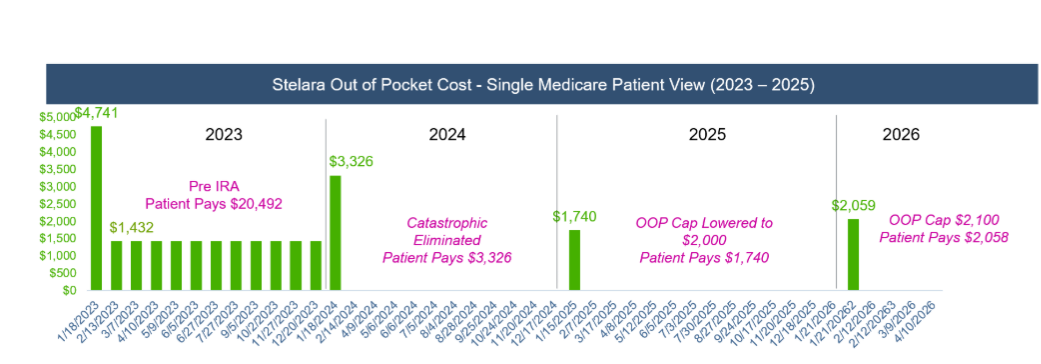
Pre-IRA, costs were spread across the year but still substantial. Even in catastrophic coverage, the patient owed 5% per prescription, a considerable amount for a drug like Stelara. After the redesign, both the annual burden and the initial fill are lower, but the first fill can still create a meaningful counter shock before the year's affordability becomes clear. This patient hit the cap on the first fill each year, and every remaining fill was effectively $0. The benefit is more affordable than ever across the year, but still difficult to see clearly on day one. While this patient stayed adherent regardless, the pattern shows the trap patients on the margin can fall into.
Why Patients Still Abandon at the First Fill
First-fill cost has always been a trouble spot in access analytics: abandonment rises sharply as cost increases, especially past a few hundred dollars. The Stelara Medicare data below directly shows this:
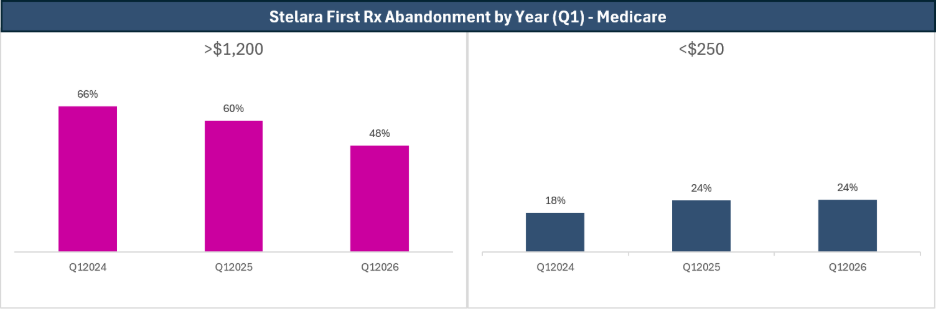
Patients facing $1,200 or more abandon at roughly two to three times the rate of those facing under $250, measured every quarter. The high-cost group is improving as the cap pulls costs down (from 66% to 60% to 48%), indicating that the redesign is working, but it remains far above the low-cost group's 18% to 24% range.
What the policy promises is straightforward: capped, then free. What the claims show is that many patients still see the ~$2,000 cost in January and abandon treatment before reaching the affordable part of the year. Some may be discouraged enough by that first experience that they never come back for a second fill.
The shock may be doing more than creating a cash-flow problem. It may also expose a knowledge gap: patients may not realize that once they hit the cap, subsequent fills are $0. Claims show the behavior, not what the patient understood in the moment, but the case is strong that patients abandon at a steep upfront cost even though later fills are free, and the program built to relieve exactly this cost sits almost entirely unused.
Medicare Built the Fix; Almost No One Is Using It
CMS anticipated the impact of high upfront costs and built the Medicare Prescription Payment Plan (M3P) to address the timing issue: $0 at the pharmacy counter, repaid in capped monthly installments closer to $175 per month. It's the purpose-built solution for a first-fill burden that didn't go away, even though annual and initial fill costs improved, and it's mandatory for every plan to offer, free to elect, and available to any enrollee at any time.
Unfortunately, adoption is low: only 0.53% of Medicare Part D patients had used M3P through June 2025, and only about 15% of beneficiaries most likely to benefit had enrolled.
From a Money Problem to a Knowledge Problem
The challenge no longer appears to be benefit availability; it is awareness, understanding, and execution. Patients don't know M3P exists, don't understand it when they encounter it, or hit confusion at the point of sale, and the fix sits on the shelf, unused.
None of this is an affordability problem in the traditional sense. The annual cost barrier has largely been fixed; what remains is a knowledge-and-behavior problem, far cheaper to address than a pricing concession, benefit redesign, or new legislation. The solution requires visibility and timing – the right information to the right patient at the moment of the first fill.
What Claims Analysis Can Do
The same claims analysis that surfaces the first-fill burden can also address next steps:
- Measure the burden at different OOP levels. Together, OOP bands, fill timing, and reversal behavior identify fills at risk.
- Target where the burden concentrates. The same analysis shows which specialties, geographies, and plan types drive most abandonment, so effort goes where it's needed most.
- Quantify the opportunity. Identifying patients exposed to high first-fill costs and estimating abandonment sizes in the pool most likely to benefit from targeted support.
- Value first fills correctly. A lost first fill for a chronic specialty therapy is closer to four to seven fills of lost value, not one, which is what makes the ROI far larger than a single-Rx view suggests.
The analysis doesn't need to directly prove M3P adoption. It can identify where first-fill cost is still creating abandonment and show where targeted education would be most effective at changing behavior.
From there, the intervention has two layers: branded outreach to the HCPs and geographies where the barrier is most concentrated, and broader, unbranded education on the cap and on payment smoothing, since the knowledge gap is not product specific.
Where Predictive Access Fits
This is not the same gap as a payer quietly managing access tighter than declared. The Part D design is visible on paper: the cap is real, the first-fill exposure is knowable, and M3P is available. The questions are:
- What happens when patients meet that design in the real world and only claims answer it?
- Do patients fill, abandon, delay, or continue?
- Where can support change behavior?
Policy tells us what should happen; claims reveal what patients actually do.
The Manufacturer Takeaway: Learn More with Precision AQ
For manufacturers, the next challenge is not affordability alone but understanding where patients fall out of therapy despite a favorable design, and which interventions improve persistence.
If you want to understand where patients are hitting first-fill friction, which segments are most vulnerable, and how predictive analytics can prioritize interventions before patients are lost from therapy, let's talk.